
PlayPredict
Founder · Product Design · Development
2–3 Months (MVP Build)
1 Frontend · 1 Backend · 1 QA · 1 PM
PWA (Web) · Mobile App
In Active Development
Executive Summary
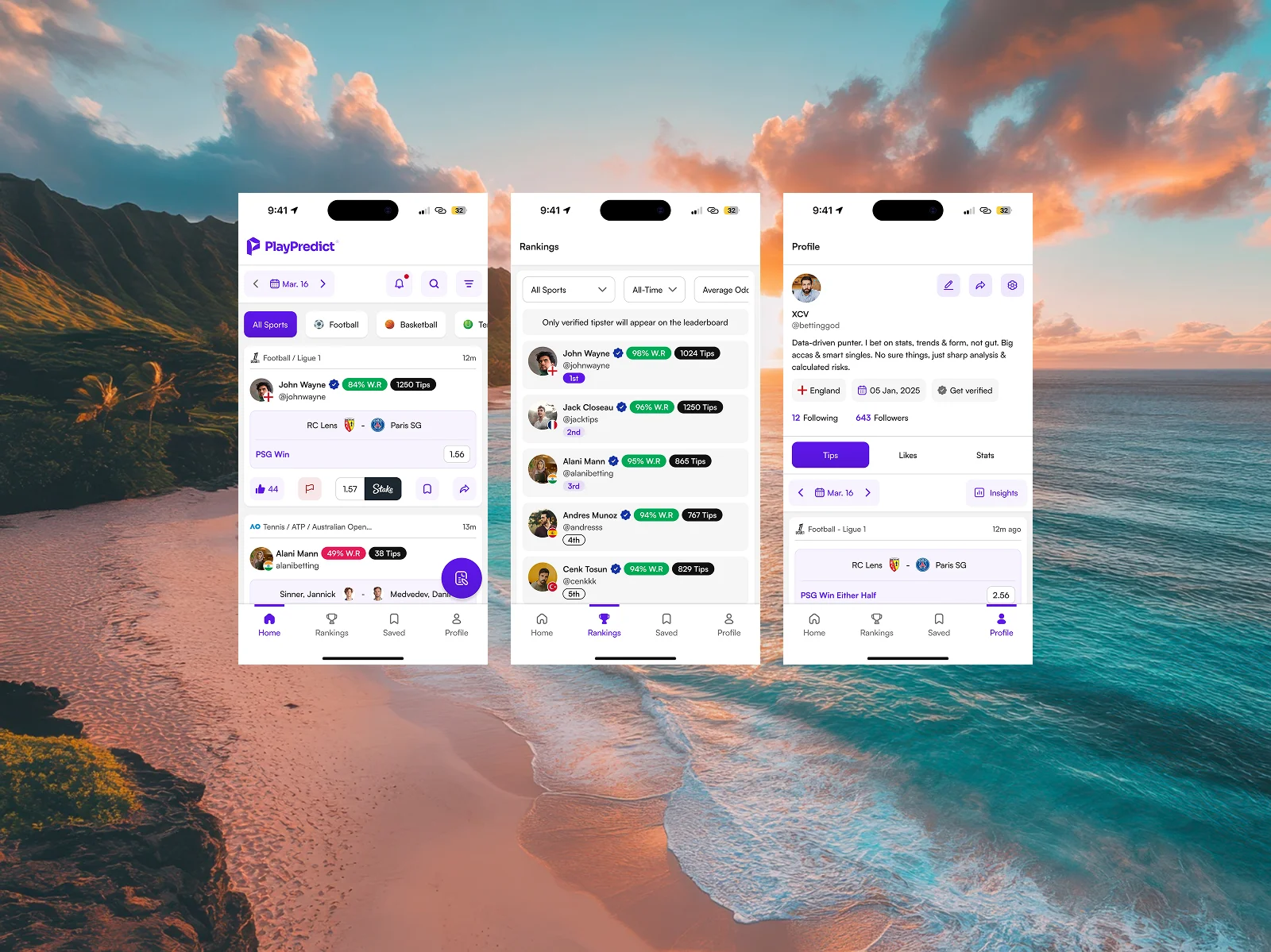
PlayPredict is a sports prediction platform designed to make shared predictions structured, transparent, and measurable. Instead of relying on screenshots or free-text tips, users publish predictions from standardized sports and betting-market data.
Sports predictions are often shared across fragmented social platforms where performance is difficult to verify over time. PlayPredict creates a persistent public track record, making it easier to evaluate a tipster’s results, compare performance, and discover credible predictors.
I defined the product strategy, prediction flows, ranking and qualification rules, performance metrics, anti-abuse systems, monetization model, and end-to-end UX. I am now building the frontend with Codex, using AI-assisted development to translate the product system into working software while collaborating with backend engineering on APIs, validation, settlement, and platform logic.
Homepage Experience
Product Vision
The long-term vision for PlayPredict is to become the trusted performance layer for sports prediction creators globally.
By separating prediction publishing from betting execution, the platform focuses on credibility, transparent performance history, creator discovery, and a product experience built around predictions rather than wagering.
The long-term goal is to evolve into a marketplace where proven tipsters can build an audience and monetize access to premium predictions, while users can make subscription decisions using transparent historical performance.
Problem Space
Sports predictions are commonly shared across fragmented channels such as X, Telegram, and other communities. Posts can be edited, deleted, selectively highlighted, or presented without a consistent record of previous results.
That makes it difficult for followers to judge credibility, compare tipsters fairly, or understand whether strong recent results reflect consistent performance or a short winning run.
PlayPredict addresses this by turning predictions into structured, trackable records with settlement results, performance metrics, ranking rules, and public profiles.
Core Product Mechanics
PlayPredict operates on a single-user-type system where every user can publish predictions, follow creators, and build a public track record.
Structured Betting Markets
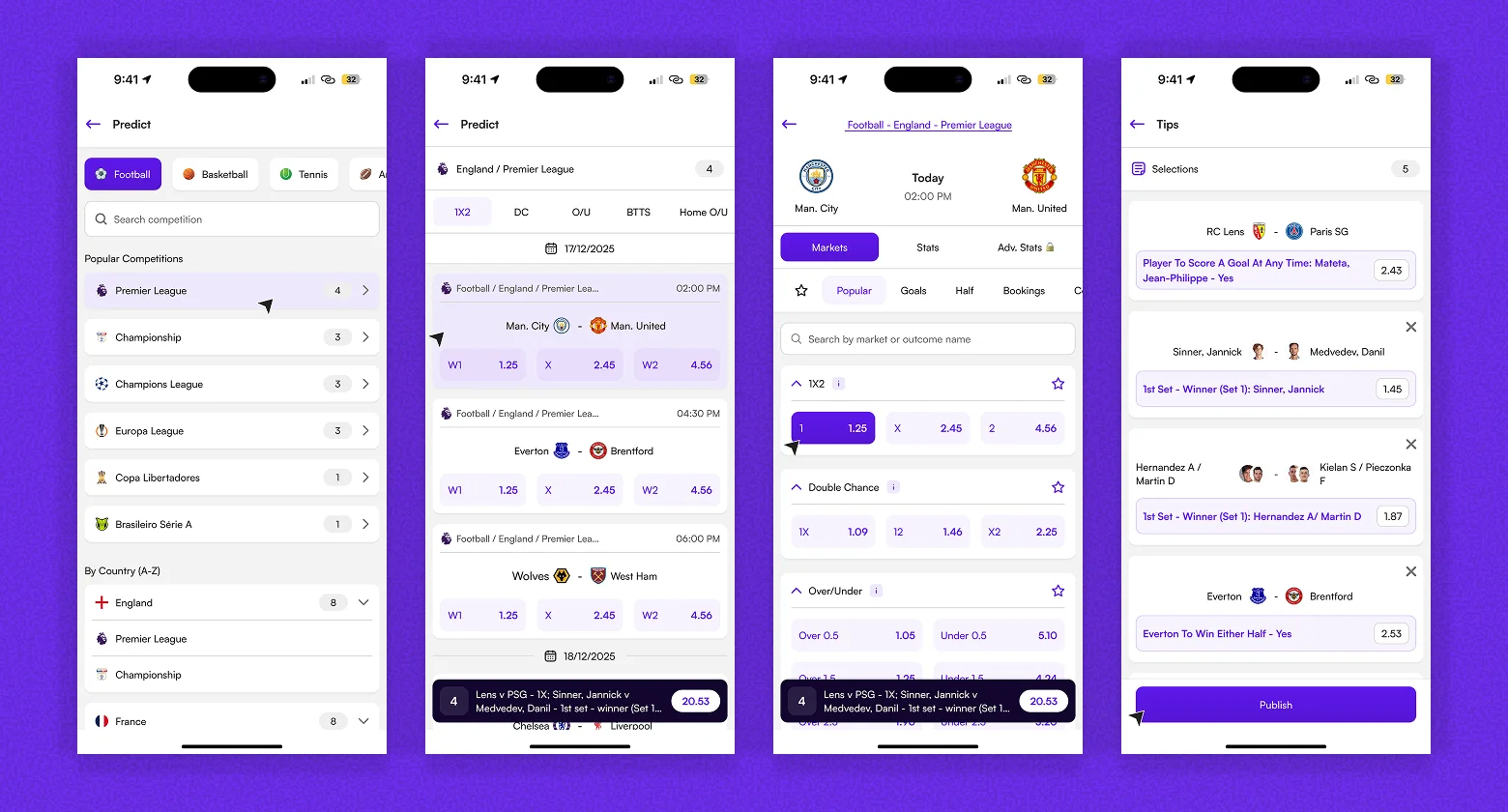
Predictions are created from API-supplied betting markets, ensuring standardized inputs across sports.
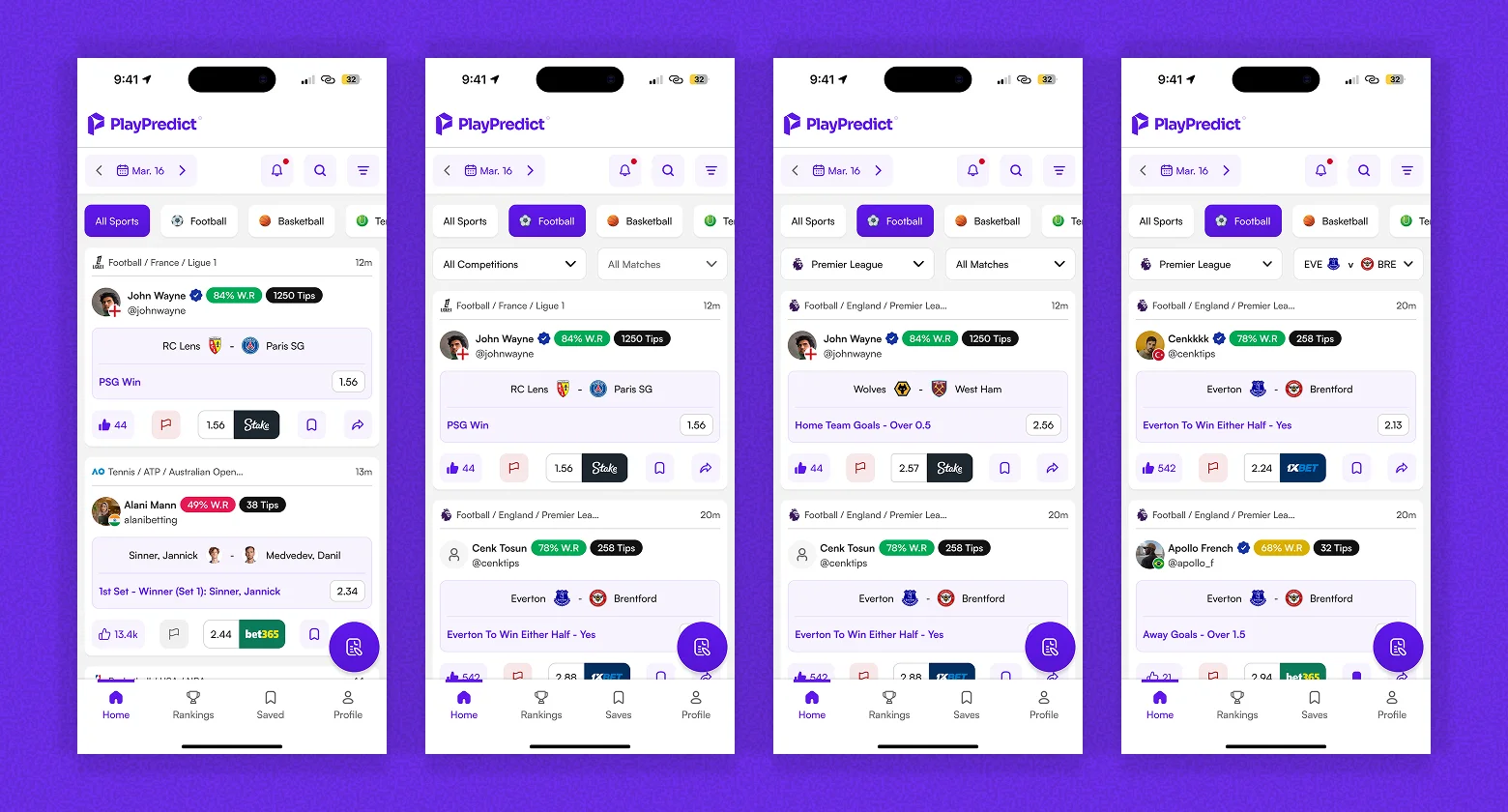
Date-Driven Discovery
Calendar filters mirror sports app behavior — users filter by match date, not posting date, ensuring prediction relevance.
Advanced Filtering
Users can filter by sport, betting market type, odds range, tipster category (all, followed, verified), and more.
Creator Discovery & Engagement
Following, bookmarking, shareable profiles, and notification preferences help users keep track of tipsters and return to predictions they care about.
Prediction Creation Flow
Prediction Integrity & Anti-Abuse
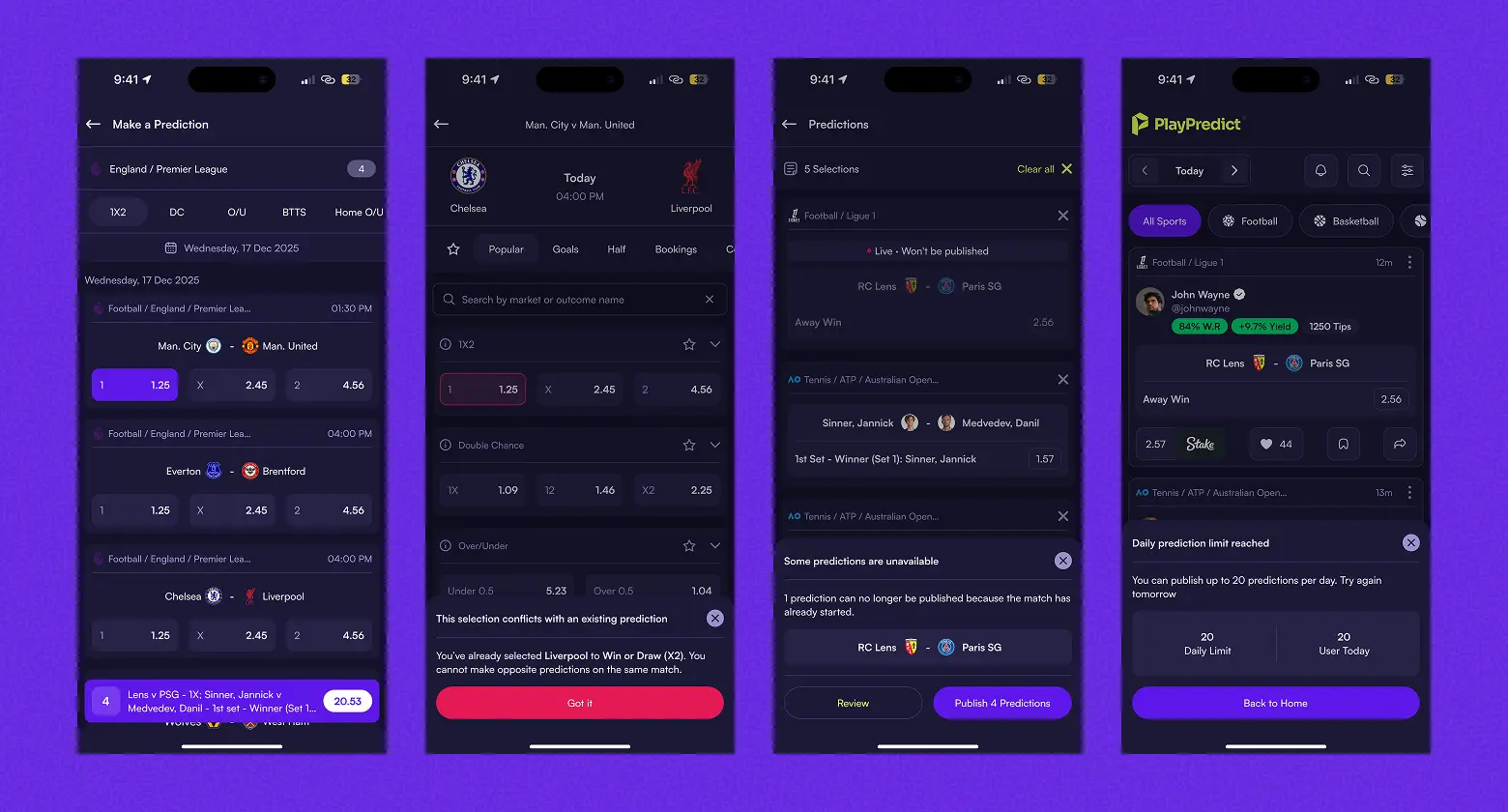
Because public performance affects credibility and leaderboard position, the publishing system includes guardrails that prevent users from manipulating their record through contradictory picks, deletion, or excessive selections on the same fixture.
Contradictory Pick Prevention
Conflicting selections for the same fixture are disabled during prediction creation, including conflicts with predictions the user has already published.
Per-Fixture Selection Limits
Users can publish a maximum of five non-contradictory selections on a single match, limiting excessive market stacking while still supporting different prediction angles.
Immutable Published Predictions
Once published, predictions cannot be deleted. The historical record remains intact so poor results cannot simply disappear from a creator’s public performance.
Publishing & Daily Limits
Publishing limits control prediction volume across individual submissions and each day, reducing spam while keeping the creation flow manageable.
Transparency & Trust Infrastructure
Trust is the core product differentiator. Every prediction is publicly trackable and contributes to a visible performance history.
Public Performance Metrics
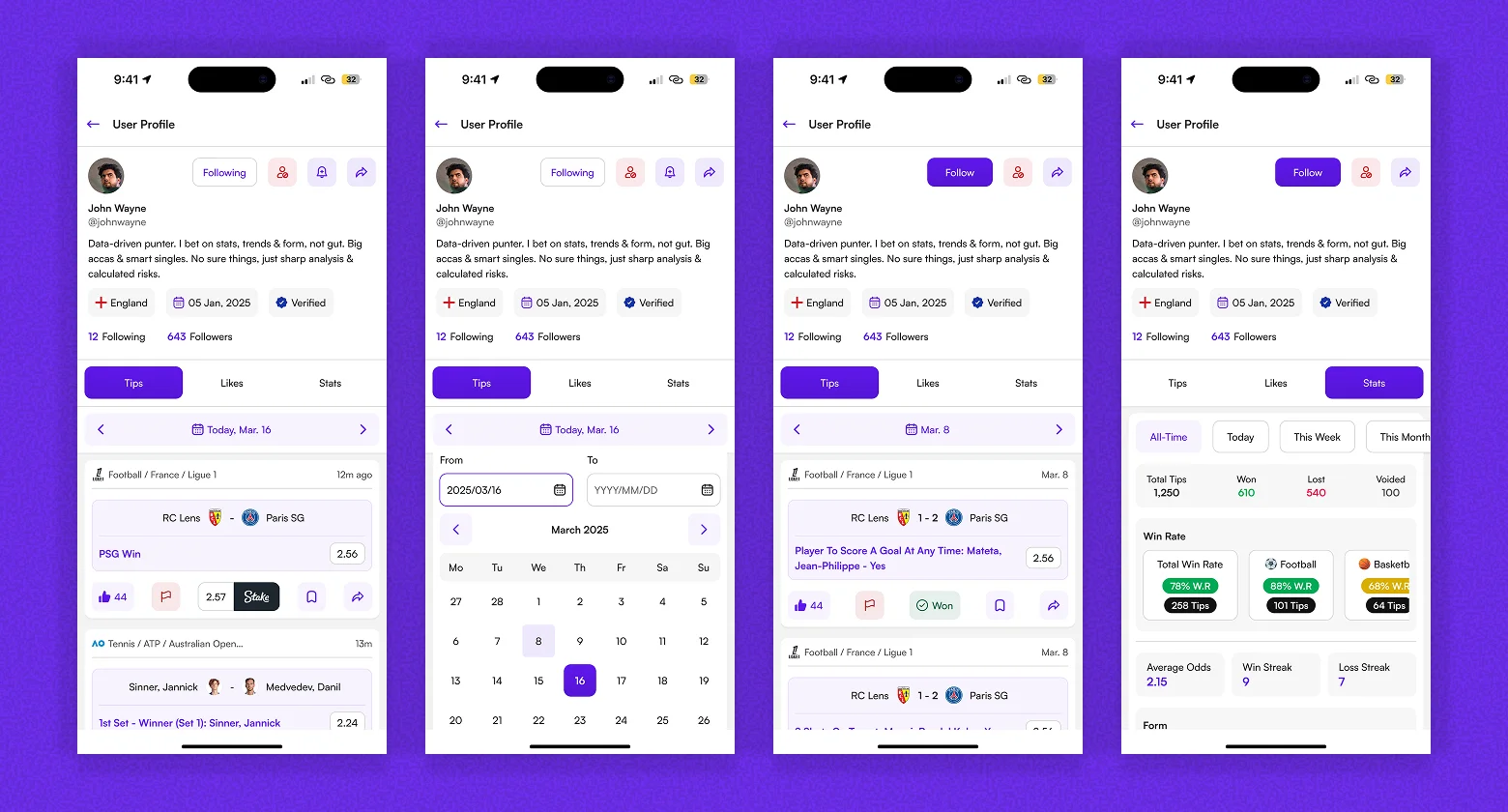
Profiles surface metrics including ROI and win rate so users can evaluate performance beyond the outcome of a single prediction.
Performance Analytics
Performance views combine settled prediction history with metrics such as ROI, win rate, average odds, wins, losses, voids, form, and prediction volume.
Calendar-Based History
Users can audit any creator’s historical picks by selecting match dates through the integrated calendar system.
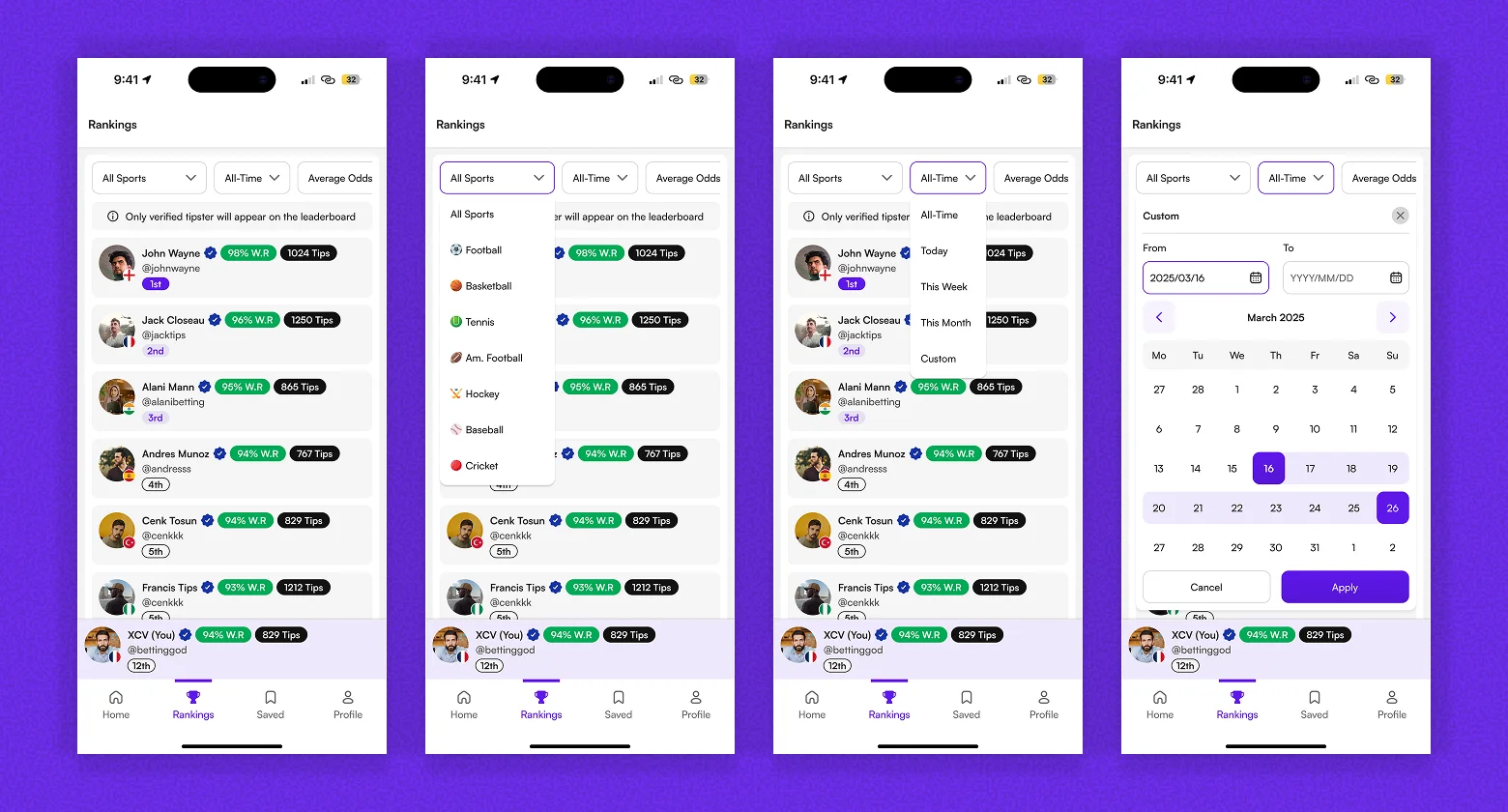
Verified Weekly Leaderboard
Verified users compete on a weekly leaderboard ranked primarily by ROI and then win rate, with minimum activity and settled-prediction requirements designed to reward sustained participation.
Performance & Ranking System
The ranking system is designed to reward performance without making it easy to game the leaderboard through a tiny sample of picks or extremely low-risk selections.
Weekly competition uses clear qualification gates alongside ROI and win rate, while voided predictions can contribute to activity requirements without improving ROI.
ROI-First Ranking
Qualified users are ranked primarily by ROI, with win rate used as the secondary performance measure.
Minimum Activity Thresholds
Weekly qualification requires a minimum number of settled predictions and participation across multiple days, reducing the advantage of one-off prediction dumps.
Odds & Activity Guardrails
Minimum average-odds and activity requirements discourage low-odds stacking and other strategies that could distort leaderboard performance.
Public Auditability
Published predictions and settled results remain visible through a user’s history, making leaderboard performance auditable from the underlying picks.
Creator Profile & Public Analytics
Monetization Strategy
Version 1 is designed around advertising and affiliate sportsbook partnerships, keeping monetization separate from the core prediction and ranking experience.
A later version introduces paid subscriptions for verified high-performing tipsters, allowing creators to offer premium predictions while PlayPredict takes a platform fee.
PlayPredict does not facilitate betting transactions. Users publish and evaluate structured sports predictions, while any sportsbook activity happens outside the platform.
Key Design Decisions & Trade-offs
A key structural decision was aligning calendar filtering behavior with established sports app mental models. Users filter by match date, not publishing date — preserving contextual relevance.
Enforcing API-based betting market selection eliminated free-text manipulation, ensuring statistical integrity and comparable data across all creators.
The leaderboard required anti-gaming constraints including minimum active days, settled-prediction thresholds, average-odds requirements, verified-user eligibility, and rules that prevent contradictory selections from being used to manipulate performance.
Every system decision balanced three forces: usability, fairness, and scalability.
Strategic Potential
PlayPredict bridges the gap between social prediction communities and structured performance analytics.
With verified tipster subscriptions and deeper performance tooling planned beyond the MVP, the platform can evolve from a prediction-sharing product into a marketplace built around measurable track records.
Weekly Leaderboard & Qualification System
Growth & Distribution Strategy
Growth is built around creator-led distribution and sports community behavior.
Creator Acquisition Flywheel
Smaller and mid-tier sports tipsters are prioritized, offering ranking visibility and monetization potential.
Shareable Profile Links
Public stat transparency encourages external traffic from Twitter and Telegram communities.
Affiliate Revenue Loop
Partnerships with betting companies create aligned incentives without hosting bets internally.
Future Subscription Ecosystem
Verified tipster subscriptions can create recurring creator revenue while giving users a performance-informed way to access premium predictions.
Platform Governance & Integrity
Platform credibility required clear moderation and anti-abuse rules around copied predictions, contradictory picks, leaderboard manipulation, and suspicious activity.
Structured Reporting System
Users can report suspicious or copied predictions through predefined moderation reasons, giving the admin team structured cases to review.
Administrative Review Workflow
Flagged content routes into an admin moderation queue with structured decision logging.
Prediction Locking Mechanism
Published predictions cannot be deleted, and contradictory selections for the same fixture are blocked across both the current publishing flow and previously posted predictions.
Eligibility Transparency
Qualification rules and leaderboard status are surfaced clearly so users can understand why a tipster is or is not eligible for weekly ranking.
Design to Development
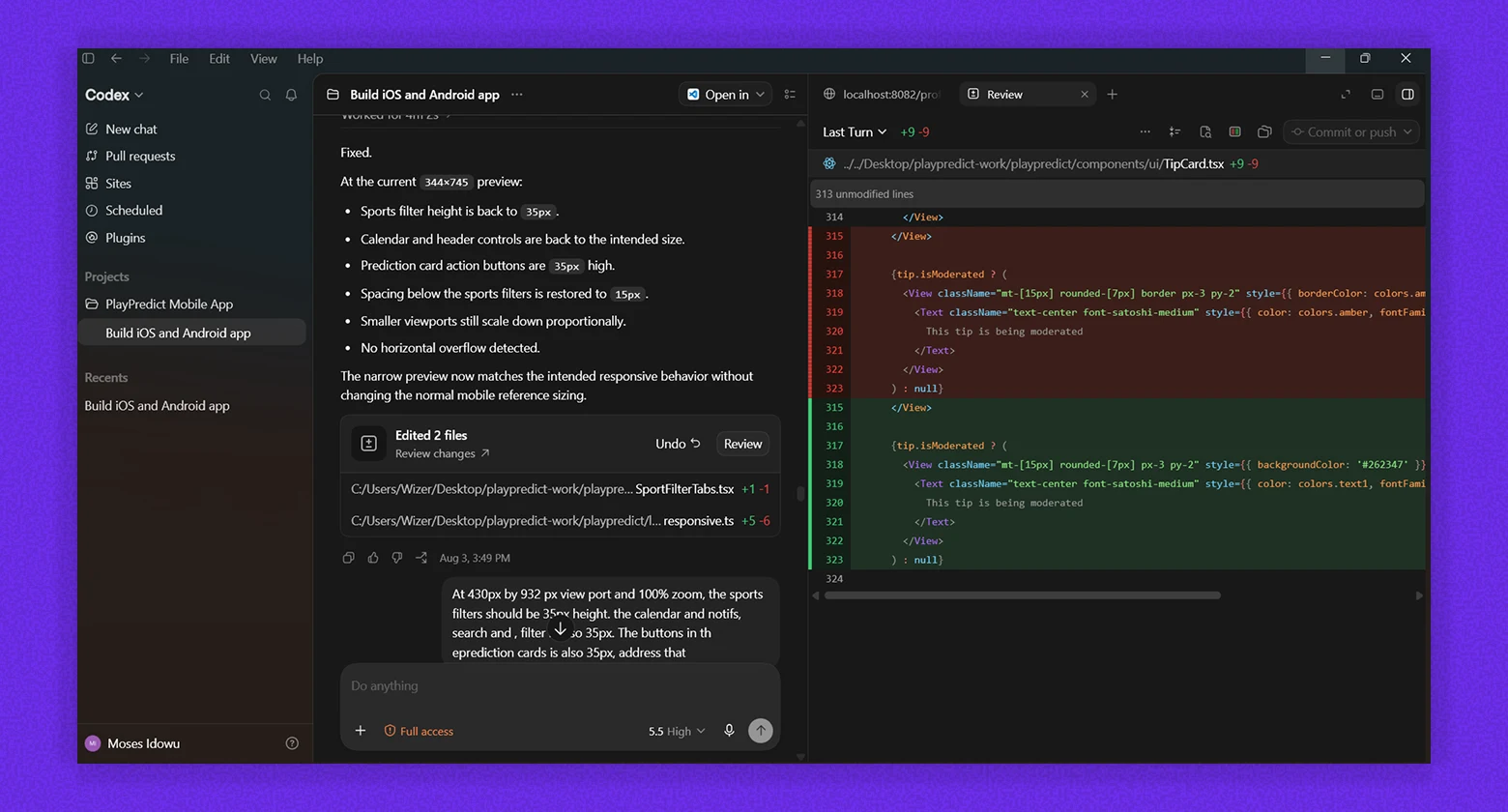
PlayPredict evolved from a product design project into a hands-on build. After defining the product strategy, UX, interface system, and core logic in Figma, I began developing the frontend using Codex, translating design decisions directly into working software through AI-assisted development.
I work alongside backend engineering to define APIs, validation logic, ranking rules, data structures, and other system requirements while owning the product experience from design through frontend implementation.
Design Leadership Reflection
Building PlayPredict required thinking beyond interface design into product rules, data structures, ranking incentives, moderation, monetization, and the edge cases created by real-time sports data.
The project has pushed me to work across product strategy, UX, system logic, frontend implementation, and backend collaboration—designing not only how the product looks, but how it behaves when real users, live fixtures, settlement states, limits, and abuse cases interact.